
Our latest eBulletin, sent out to subscribers on Tuesday, 5 May 2026
There are some basic facts about the characteristics of those the justice system processes that do not appear to change over time.
For one thing, the large majority of those prosecuted and convicted tend to be male: over 80 per cent of all offences currently, rising to over 90 per cent in the case of violence and sexual offences.
For another thing, Black people are far more likely to end up being arrested, prosecuted and convicted than White people. This is a general feature of the justice system. It is also a feature of many of the various sub-systems and processes within.
Take joint enterprise, for instance. Our recent report – Joint Enterprise: A view over time – found that Black people have comprised, over the past two decades, around 25 per cent of defendants in homicide cases involving four or more defendants, while representing only four per cent of the general population.
The perceived company that Black defendants keep – in particular claims about ‘gang’ affiliations – has played a significant role.
The result is dehumanising, turning prosecution into a ‘job lot’ exercise, rather than a fair-minded attempt to get to the bottom of what went on, and who did what.
As Patrick Williams – one of four excellent speakers at our event on joint enterprise last week – observed: “When the jury see five young Black people in the dock, they don't see five individuals. They see one Black gang”.
The injustices of joint enterprise sit within a wider set of problems, some specific to the justice system, others deeper and societal. What is more, while reports and statements from government, parliament and civil society organisations regularly identify the problem, nothing seems to change.
‘Something must be done’ all too often seems to slip into nothing will be done.
What would it mean for race and racism to be taken seriously by the justice system, decision-makers and wider society? How would we recognise meaningful change if it were to be achieved?
We are going to be exploring these and related questions at our forthcoming event – All talk, no action? – on Wednesday, 3 June, where we will be joined by three excellent and insightful speakers: Dr Jason Warr, Khatuna Tsintsadze, and Dr Angela Charles.
As with most of our events, it will be available to attend both in-person (with delicious food and refreshments following the main event to help us continue the conversation) and online, for those unable to attend in-person.
I hope to see you there.

Richard Garside
Director
Register today: All Talk, No Action?
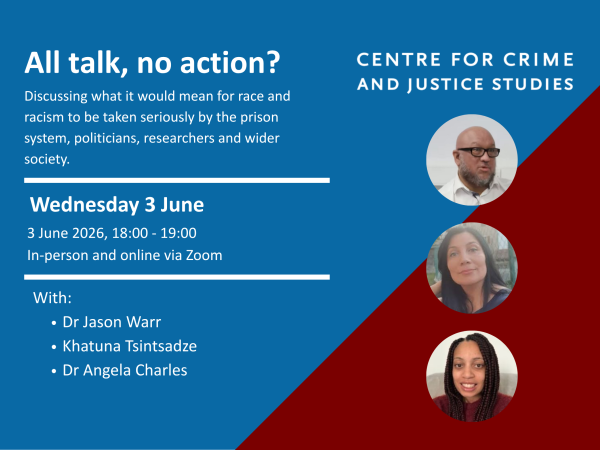
Our next event, on 3 June, will examine the enduring challenge of racism across the criminal justice system.
Despite decades of research, advocacy, and public debate, progress on racial inequality in prisons and the wider justice system has been limited. This event asks why, given general agreement on the need to tackle racism in the justice system, nothing seems to change.
The discussion will explore why race and racism continue to be marginalised in research and policy, and reflect on key questions including the legacy of the murder of Zahid Mubarek, the experiences of Black women in custody, and the barriers faced by those working to drive reform.
We will be joined by:
- Dr Jason Warr, Associate Professor of Criminology at the University of Nottingham;
- Khatuna Tsintsadze, Co-Director of the Zahid Mubarek Trust; and
- Dr Angela Charles, Senior Lecturer in Criminology at the University of Northampton.
The panel will consider what it would mean for race and racism to be taken seriously across the justice system, and how meaningful change might be recognised in practice.
Date: 3 June 2026
Time: 6:00–7:00pm
Location: In-person and online
Click here for more information and to register.
Following the main event we will be serving delicious food and refreshments to those who attend in-person.
Joint Enterprise: A view over time
Last month we published Joint Enterprise: A view over time, a new report examining trends in multi-defendant homicide prosecutions in England and Wales.
Drawing on Home Office and Crown Prosecution Service data from 2005 to 2024, the report finds a sustained rise in cases involving multiple defendants. It highlights concerns around fairness, with young people disproportionately represented among those convicted, alongside persistent racial disparities and increasingly severe sentencing outcomes.
The report situates these trends within wider debates on joint enterprise and shared responsibility for serious crime, and sets out three areas for reform:
- narrowing the scope of the law;
- introducing more proportionate sentencing for secondary parties; and
- improving transparency and accountability in charging decisions.
Lead author, Liat Tuv, reflects further on the report themes in a comment piece, Beyond ‘job lot’ joint enterprise prosecutions. With growing institutional attention on joint enterprise, she argues, there is an opportunity to reconsider how “job lot” prosecutions operate in practice, and how individual conduct and intent are assessed in both prosecution and sentencing.
We are grateful to the Barrow Cadbury Trust for supporting this work.
Previous event: Joint Enterprise in the Balance?
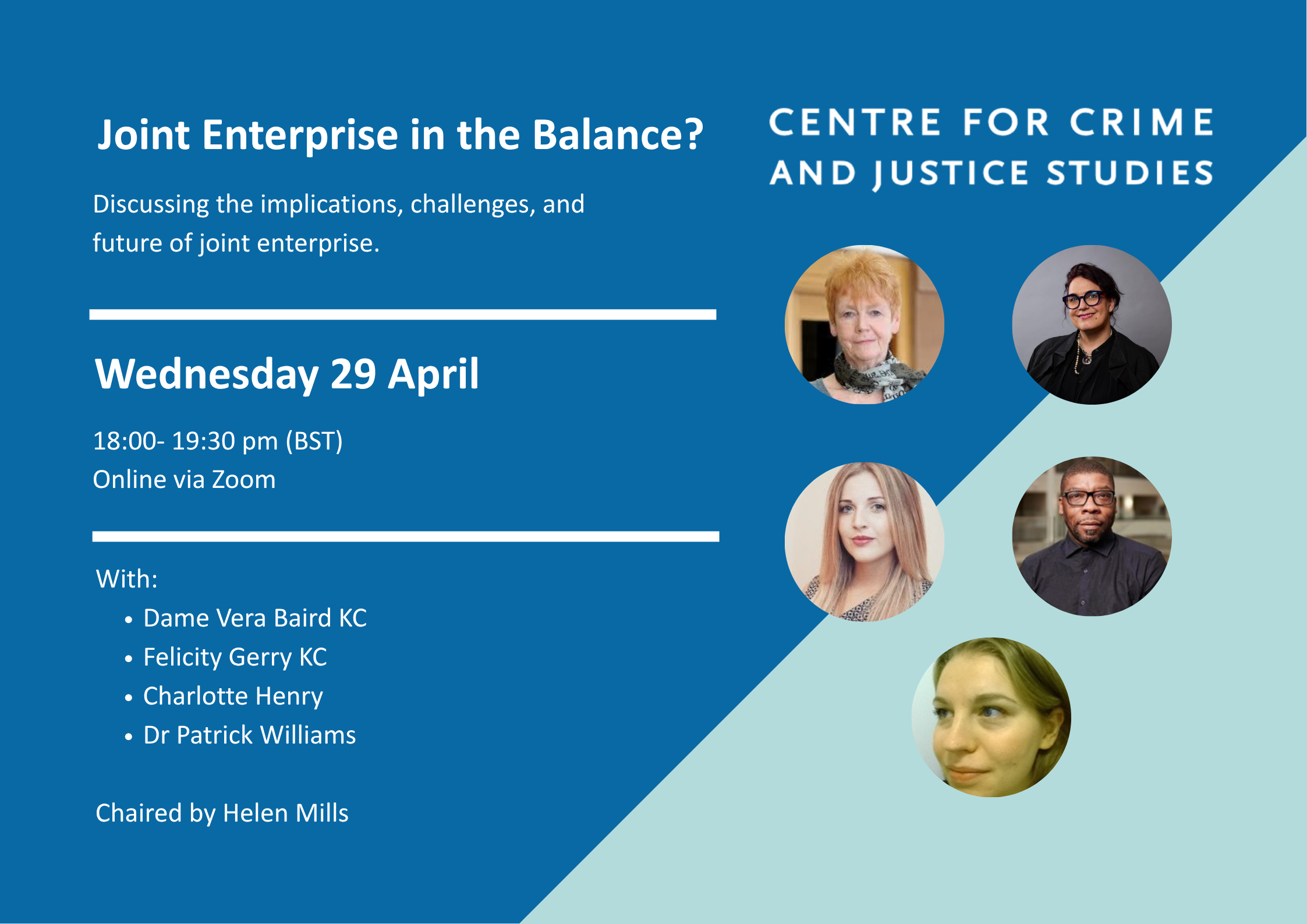
Staying with the joint enterprise theme, last week we hosted a panel discussion, bringing together experts, researchers and campaigners to discuss why it is a popular prosecution tool, the challenges facing those affected, and the prospects for meaningful reform.
The panel featured Dame Vera Baird KC, Chair of the Criminal Cases Review Commission; Felicity Gerry KC, who led the successful Supreme Court appeal that forced a change in the law; Charlotte Henry of Joint Enterprise Not Guilty by Association (JENGbA); and Dr Patrick Williams, independent researcher and co-author of our report, Dangerous Associations.
The event was chaired by our colleague Helen Mills.
We will be publishing a recording of the event shortly.
We are grateful to the Barrow Cadbury Trust for supporting this event.
Comment: Can’t live with ’em, can’t live without ’em
It is time to make the case for the real cost, and true value of the work, provision and service delivered by voluntary sector organisations. So argues Charlie Weinberg in this challenging and stimulating commentary. Even with coordination, she argues, some organisations will continue to participate in poorly designed contracts. What other choice do they have?
Rather than blaming or criticising individual organisations for this ‘choice’, Charlie argues that the sector should work together to create the conditions in which they can do something else. Many criminal justice organisations support communities and individuals to build agency, develop confidence and overcome financial hardship. It is important for them to apply these same lessons to themselves as well.
We told you so: Serious Violence Reduction Orders
In 2024 we published an analysis of the Serious Violence Reduction Orders (SVROs) pilot. We concluded there was little evidence of significant activity, and even less of any meaningful impact. We returned to the theme earlier this year, questioning whether SVROs were “more about visibility and being seen to be doing something on a politically charged issue, rather than a well-evidenced contribution to reducing knife crime”.
The official SVRO evaluation, out in April, agrees. It finds that SVROs increased stop and search among those subject to an order, but to little effect. Across 315 searches, just one weapon was found. Of more than 6,000 eligible individuals, fewer than 500 orders were issued, with courts often rejecting applications as unnecessary or disproportionate. The Orders also had a significant impact on vulnerable groups, including homeless people.
The government has not yet confirmed whether SVROs will be rolled out more widely.
Comment: Redesigning Electronic Monitoring for resilience
This month we published an interesting piece on a research-led prototype developed by MSc/MA Innovation Design Engineering students at Imperial College London and the Royal College of Art.
While the use of electronic monitoring (EM) is expected to grow, the authors argue that the tags and associated technology have seen little meaningful redesign. Their proposed design, Beacon, reimagines EM as an interconnected system, pairing a redesigned tag with a probation-facing interface to improve clarity and context.
Read the full piece on our website.
What’s what in The British Journal of Criminology?
For more than sixty years, The British Journal of Criminology (BJC) has published some of the most significant research in the field.
A number of open-access articles were published this month:
- Michael A Hansen and John C Navarro investigate public attitudes to the sentencing of juvenile murder offenders.
- Sylvia Walby, Brian Francis, and Jessica Phoenix show that methodological choices in official crime statistics for England and Wales significantly understate violence against women and girls.
- Kiseong Kuen and Seung Hyun Kim explore what makes the police confident in their own authority.
Staying with the BJC, the inaugural annual BJC symposium is taking place in Oxford on Wednesday, 17 June 2026.
The keynote speaker will be Professor Robert Sampson of Harvard University, who will be talking about how long-term social processes shape patterns of crime, justice, and inequality.
Places at this in-person-only event are strictly limited. If this feels like your bag, check out the event page to find out more, including how to request a place.
Prison Service Journal archive
We are in the process of digitising and uploading the entire back catalogue of Prison Service Journal, from the first edition in 1960. A complete run from 1960 to 1995 is currently available, alongside a complete run from July 2010 to the present day.
This month, the editors have highlighted articles from editions 28, 29 and 30.
Edition 28
Staff participation, by Norman Low, examines staff participation in prison decision-making, highlighting its impact on morale, institutional culture, and reform. It advocates inclusive practices to enhance legitimacy, wellbeing, and operational effectiveness.
Edition 29
The Neighbourhood Borstal by staff at Hewell Grange, describes an experimental reform in the 1970s, linking young people in custody to their home communities by grouping trainees from the same local areas and fostering close collaboration between prison and probation services. The scheme aimed to improve rehabilitation through stronger local identity, community work, and family contact. Despite challenges, staff turnover, cultural adjustment, and uncertain effects on reoffending, reports noted better probation liaison and family involvement, suggesting the neighbourhood borstal offered a more humane, community-connected approach to the treatment of young people convicted of crime.
Edition 30
D. Long, in the article The Swansea Experiment, describes the shift from rigid, punitive prison practices toward a rehabilitative model emphasising staff-prisoner relationships and group work, supported by extensive officer training in social skills, psychology, and group dynamics. Through structured courses and in-service group sessions, staff developed confidence and expertise, enabling the creation of prisoner-officer discussion groups that fostered trust, emotional support, and practical insights for progressive management and successful reintegration.
Ground Floor Office Space Available
Looking for a bright, office in central London? We have a great ground floor office available now.
- 650 sq ft with excellent natural light.
- Raised floors, modern lighting, and air-conditioning.
- Less than five minutes from Vauxhall train, underground, and bus station.
What is more, you also get free use of a separate board meeting room at no additional cost.
All this from just £34 per sq ft—hard to beat in central London.
Find out more here or contact Jeanie Reid at info@crimeandjustice.org.uk.
Support our work
In the last 12 months, around one pound in every ten we received in income came from individual donations. We are so appreciative of the vital support we receive from our donors and supporters.
If you like what we do, and can afford to make a donation to support our important work, we would be very grateful.
You can also spread the word about our work by forwarding this bulletin to others and encouraging them to sign up.


