A research-led prototype developed by a team of MSc/MA students at Imperial College London and the Royal College of Art.
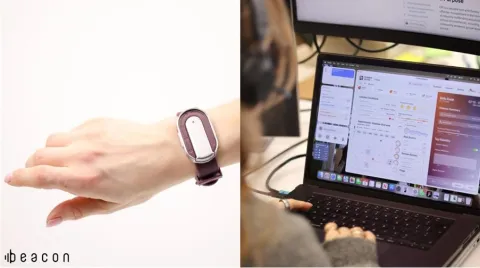
Representation of Beacon’s interconnected system
Credits: Beacon Services
By Shraddha Sunil, Ella Morgan, Rainia Gan and Antoine Mehdi El Adib
Electronic Monitoring (EM) is increasingly relied upon as an alternative to custody, particularly as prisons operate at near capacity and pressure shifts onto probation. The number of people on EM is expected to double this year, yet the service itself has not undergone a meaningful redesign for decades, with an evident lack of consideration for the nuances and complexities of the wearers’ lives.
Our intervention began from a single observation: many failures in EM are not failures of compliance, but failures of design. Alerts triggered by battery depletion or signal loss are often indistinguishable from genuine breaches. These alerts are typically triaged by monitoring contractors before reaching probation officers, often stripped of crucial context. The result is inefficiency, anxiety, and high-stakes decisions made with incomplete information.
We reframed Beacon as an interconnected service, in contrast to the current separation between hardware and monitoring systems. We focused on two key points of intervention: the wearable itself, and the way information is interpreted and acted upon.
Through qualitative research, we mapped the system end-to-end, revealing consistent friction points—particularly the gap between the data gathered and what is required by probation officers to make proportionate, informed decisions. Interestingly, identical design requirements emerged from stakeholders with opposing concerns.
Our hardware and software prototypes respond to the needs of both parties in the system: the wearer and the probation officer. They aim to demonstrate the impact of bringing context, clarity, and humanity into Electronic Monitoring.
Key Research Insights
- Comfort, dignity, and clear feedback improve compliance: Pain, stigma, unsafe charging, and lack of feedback increase anxiety and the risk of tampering. Interviews with wearers suggest that improved comfort and simple, legible feedback could reduce tampering and increase voluntary compliance.
- Punishment is the loss of freedom, not physical pain: Discomfort and visible stigma do not improve safety or rehabilitation. Participants described how device visibility can increase vulnerability and public judgement. This effect is amplified for more vulnerable groups, leading to disengagement from community life. Some interviewees reported avoiding exercise or social interaction due to the visibility of the device.
- Context is essential for fair decisions: Alerts often lack the contextual information needed for proportionate decision-making. This can lead to unnecessary escalation, defensive practices, and delayed verification, sometimes only after recall has already occurred.
- Fragmented systems introduce harm: Unclear data, fragmented platforms, manual updates, and inconsistent fitting practices create errors, inefficiencies, and distress - particularly for women and families. Such discrepancies come at both a social and societal cost to the British public. Conversations with charities and a retired probation officer made it clear that there is a strong need for access to clear, transparent data and violation timelines.
Our Intervention: Beacon
Hardware:
We developed a high-fidelity physical model of a wrist-worn device designed with comfort, reliability, and discretion in mind. The design aims to reduce physical and psychological burden while improving usability. Charging, one of the most common points of failure, has been reconsidered to better fit into daily life. The device also explores intuitive, screen-less feedback to improve clarity and reduce uncertainty around device status.
Software:
Alongside this, we developed a conceptual software architecture and probation-facing interface that rethinks how monitoring data is displayed and interpreted. By improving how information is structured and contextualised, the system aims to support clearer, more proportionate decision-making. It is designed to integrate with existing workflows, improving data legibility and reducing administrative burden.
Impact & Future Direction

Working through physical features iterations
Beacon is our final year group project developed within the MSc/MA Innovation Design Engineering programme at Imperial College London and the Royal College of Art. Guidance from academic staff working at the intersection of design and criminal justice innovation was key to quickly build an understanding of a system we had not previously engaged with.
Beacon was iteratively developed through interviews, workshops, and prototyping, engaging practitioners, charities, and individuals with lived experience of Electronic Monitoring. These processes have helped validate the relevance, direction, and ethical grounding of the proposal, while further technical testing and real-world evaluation remain areas for future development. Our work was received positively by both our engineering and design professors as well as external engineers, designers and practitioners we engaged with.
Our findings suggest that Electronic Monitoring does not need to become more punitive to be effective. It needs to become more precise. By introducing greater clarity and context into monitoring systems, Beacon has the potential to support probation practice, reduce unnecessary recalls, and limit avoidable harm to families and communities.
Future work will focus on technical validation and pilot testing with practitioners, aligned with recent Ministry of Justice recommendations for proportionate, user-led approaches to EM. We are currently seeking research funding and collaborators to support this next phase, with a particular focus on working alongside women subject to EM and within probation services.
Context is crucial to the credibility and legitimacy of Electronic Monitoring.
Beacon is a step toward making that possible.
For more information please contact hello@beaconservices.uk


