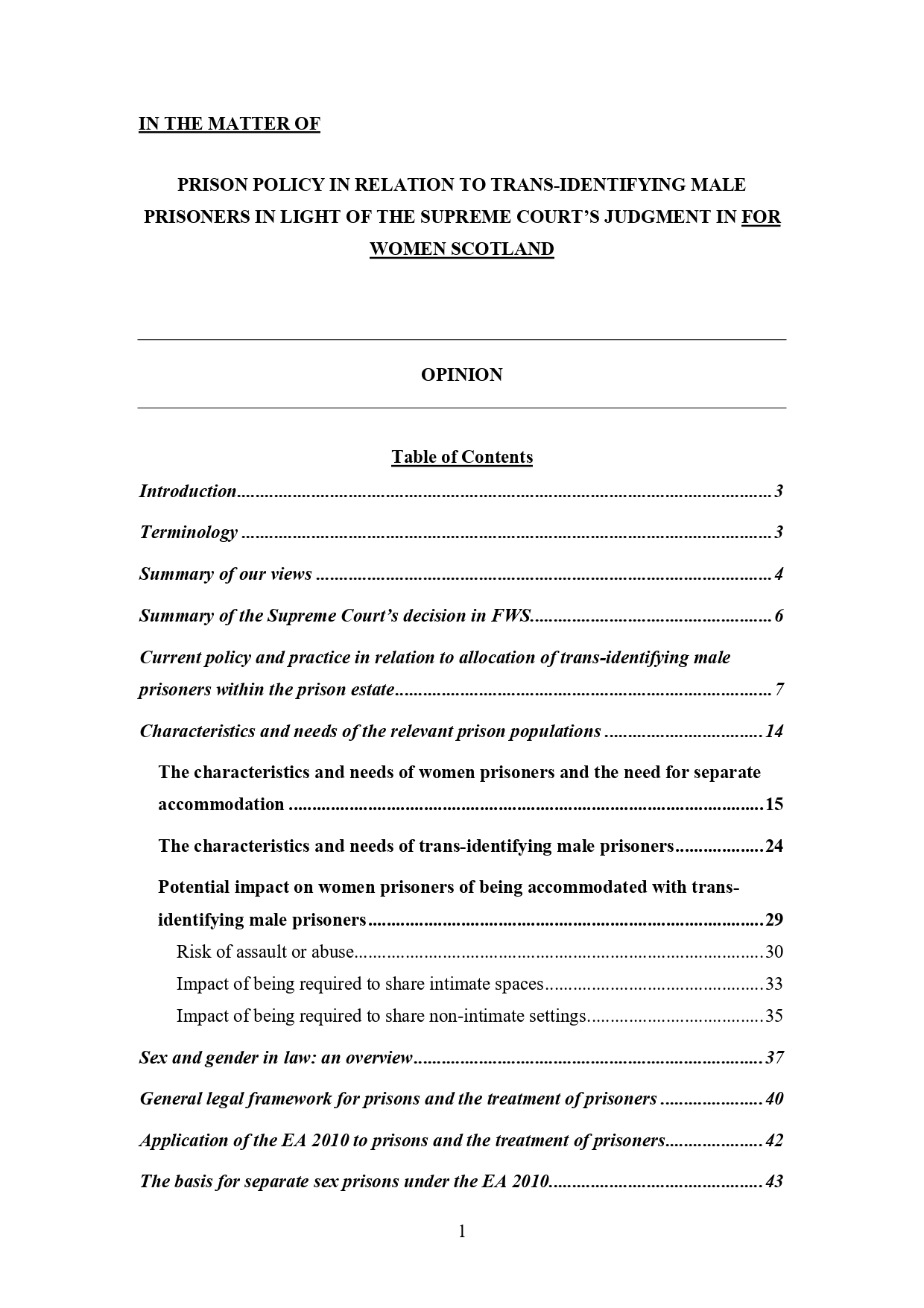
In April 2025, the Supreme Court clarified that the meaning of “man”, “woman” and “sex” in the Equality Act 2010 means birth sex/biological sex.
The judgment has implications for criminal justice organisations, including in relation to the current policy of housing some trans-identifying male prisoners in the women’s prison estate.
This Opinion, by the barristers Ben Cooper KC and Myles Grandison, advises on the implications of the Supreme Court judgment, in particular in relation to:
- Whether, and if so in what circumstances, it may be lawful for trans-identifying male prisoners to be accommodated in women’s prisons; and
- Whether the current policy of His Majesty’s Prison and Probation Service (HMPPS) in relation to the accommodation and treatment of trans-identifying male prisoners is lawful.
The Opinion concludes that the only lawful basis on which prisons can be operated is through complete segregation of the sexes, based on biological sex. That is because separate-sex prisons are necessary to meet the rights and needs of female prisoners.
Moreover, women’s prisons can only lawfully operate as separate-sex institutions on the basis of complete segregation of the sexes, based on biological sex, and not if some, trans-identifying, male prisoners are accommodated in a women’s prison.
The Opinion also concludes that the current policy of HMPPS in relation to the accommodation and treatment of trans-identifying male prisoners gives rise to unlawful sex discrimination. In particular:
- Unlawful direct sex discrimination against other (non-trans) male prisoners, who may prefer to be accommodated within a women’s prison (for example, because they are vulnerable to violence and abuse in a men’s prison and would feel safer in a women’s prison); and
- Unlawful indirect sex discrimination and/or harassment related to sex against any female prisoners who feel that their dignity, privacy and/or sense of safety and security is undermined, or whose health and/or wellbeing is otherwise adversely affected, by being confined with a male prisoner. Such reactions are both likely and objectively reasonable given the overwhelming evidence that female prisoners, as a population, have a very high prevalence both of experience of male violence, including sexual violence, and of mental health problems.
Why we are publishing this Opinion
The Centre for Crime and Justice Studies is a public education charity with a mission to inform the public, and in particular those engaged in the administration of justice, on the principles by which the system should operate.
We have taken an interest, over a number of years, in the challenges and dilemmas surrounding the housing of trans-identifying male prisoners in women’s prisons. We recognise that this is a sensitive area of public policy, with prison staff, trade unions, civil servants, politicians and their advisors holding a range of views and perspectives.
Whatever individuals’ personal positions may be, organisations operating in this area should be operating in compliance with the law. The Opinion has been drafted and published with the intention of helping HMPPS and other organisations operating in and around prisons to ensure that they are doing so.
About the terminology used in this Opinion
In this Opinion, references to ‘sex’ and related terms such as ‘man’ or ‘woman’ are to the protected characteristic of sex under the Equality Act 2010 (‘EA 2010’), s11. Pursuant to the Supreme Court’s decision, that means biological sex.
References to ‘gender identity’ and related terms such as ‘trans’ or ‘trans-identifying’ are to the protected characteristic of gender reassignment under EA 2010, s7 – i.e. to the characteristic of proposing to undergo, undergoing or having undergone a process (or part of a process) for the purpose of reassigning sex by changing physiological or other attributes of sex.
The Opinion adopts the term ‘trans-identifying male prisoners’ to refer to male prisoners with the protected characteristic of gender reassignment who identify as women, in preference to the term ‘trans women prisoners’. It has done so in the interests of clarity, because the latter term has the potential to obscure the analysis by failing to make clear that the prisoners in question are in fact, and for the purposes of the EA 2010, men. For the same reasons, the Opinion uses pronouns which correspond to (biological) sex.
Selected media coverage
- ‘Gender war is over, now we need leadership’, The Times, 22 May 2026
- ‘It’s unlawful to hold trans women in female jails, say barristers’, Inside Time, 1 June 2026