
Our latest eBulletin, sent out to subscribers on Friday, 30 January 2026
What should we make of the government’s plans for Police and Crime Commissioners?
This week’s policing White Paper – From Local to National: A New Model for Policing – reaffirmed the government’s intention to “abolish the PCC model at the end of PCCs’ current term of office in May 2028 and transfer police governance functions to existing local government structures”.
The formal abolition of PCCs forms part of a major reorganisation of local and regional government, currently under way. Under these plans, a new category of Strategic Authority, headed by directly-elected metro mayors, will be established to coordinate a range of public service and governmental functions at a regional level.
Under the policing White Paper plans, the PCC role and powers will be transferred to the metro mayors. In those areas without metro mayors, a Policing and Crime Lead, working with Policing and Crime Boards made up of local council leaders, will perform the PCC function.
Into the next decade, the government plans a major consolidation of the existing 43 territorial police forces into fewer, larger forces, overseen by metro mayors, with a national police service, accountable to the Home Secretary, operating across the country.
While the government claims it is abolishing the PCC model of police oversight, the reality is more nuanced.
Some police forces – in London, Manchester, and Yorkshire – are already overseen by metro mayors (or the Mayor of London in the case of the Metropolitan Police), who discharge the PCC duty. This is an evolution of the PCC model, intended to integrate the PCC function more clearly into local government decision-making.
The proposed Policing and Crime Leads, in areas without metro mayors, sound a lot like a PCC by another name. They mirror, as the White Paper points out, the role of the deputy mayor for policing and crime under the metro mayors.
The White Paper proposals, in other words, build on the PCC model, rather than rejecting it. While the government is proposing the formal abolition of Police and Crime Commissioners, the spirit of PCCs looks set to live on.
Whether the White Paper proposals are ever implemented in full is a moot point. When Labour last attempted a major police reform package, in 2006, it ended in a humiliating retreat.
This time round, staying in power long enough could be the biggest obstacle Labour faces to successful implementation.

Richard Garside
Director
Upcoming Event: Fixing the Courts Backlog
We’re excited to be collaborating with the law firm, Commons, on a breakfast briefing in parliament on 4 March. Chaired by Andy Slaughter MP, we’ll be exploring how lessons from New York’s criminal justice pioneers could help address the UK courts backlog.
The event will feature:
- Andy Slaughter MP, Chair of the House of Commons Justice Committee
- Juval O. Scott, Executive Director of New York’s Bronx Defenders Service, who will be joining us in-person to discuss their groundbreaking legal work
- Sashy Nathan, Co-founder of Commons, a London-based law firm delivering holistic defence
- Additional speakers to be confirmed
The briefing will bring together international experts, practitioners, and policymakers to discuss the holistic defence model, which combines legal advice with support for mental health, housing, and other social needs.
We have a limited number of places available. If you would like to attend, please email us at communications@crimeandjustice.org.uk and we’ll do our best to get you a place.
Mike Guilfoyle Essay Prize
Earlier this month, we launched the Mike Guilfoyle essay prize 2026, co-organised with Napo, to celebrate Mike’s lifelong contribution to probation practice. The prize is open to all serving and former probation staff, as well as those in training. This year’s question is: What needs to change for probation to be more effective?
Winning essays will be published in the Napo Magazine and on the CCJS website.
Mike was a dedicated probation officer and a regular contributor to our website, writing insightful, often witty, articles that reflected the values of ‘advise, assist and befriend’. A few highlights from his work include:
- Out on the patch – reflections on probation practice and the challenges of balancing bureaucratic pressures, political interference, and personal responsibility.
- Probation in Ukraine, nothing like this – offering a lens through which the personal realities of probation work resonate with larger international events.
- Good in installments – observations on managing cases and relationships over time.
- Dodging passing traffic – showing how a fleeting moment of advocacy in a child protection conference transformed suspicion into support.
His writing continues to inspire this year’s essay prize, encouraging contributors to reflect on the heart of probation practice.
Find out more about the prize on the prize landing page.
Smaller but Tougher: Young Adult Justice
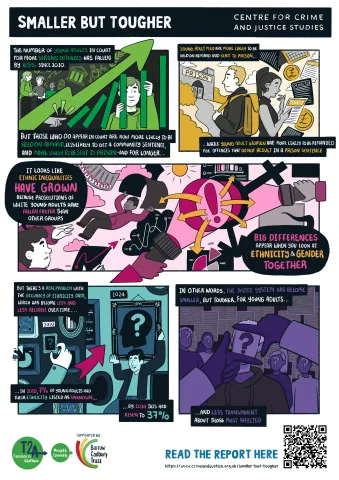
Earlier this year, our report on 15 years of data, Smaller, but tougher, showed that the criminal justice system has become smaller in scale but tougher in its impact on young adults. Fewer young people are being processed overall, but those who are face harsher outcomes, including longer sentences and higher use of remand.
Persistent gender and ethnic disparities remain a consistent feature of the system.
To help make this complex analysis more accessible, we teamed up with the illustrator Rae Goddard to produce an infographic summarising our findings. We’re now doing further work identifying practical routes to reform.
Check out our original analysis, the infographic, and ways to get involved on the project landing page.
Where is “race” in prison studies?
In the ninth paper in our Working Paper series, Dr Jason Warr examines the persistent marginalisation of race and racism in British prison research and policy.
Drawing on his extensive research into racialisation and British prisons, Jason outlines five interrelated factors contributing to the marginalisation of race and racism in prison studies, including language, ignorance, institutional norms, and the enduring legacy of colonialism.
He also examines how these factors shape both research and policy, and how they continue to influence the lived experiences of prisoners.
Our Working Paper series publishes research and analysis of an exploratory nature. Working papers are not formally peer-reviewed, but are intended to stimulate reflection and discussion on current and relevant areas. For more information on the series, and how to propose a paper, please visit our guidelines page.
Commentary and Analysis
This month, our Policy and Communications Officer, Mimi Marijetic, and Programmes Director, Helen Mills, review the latest information available on Serious Violence Reduction Orders. They argue what happened in the pilot of this controversial stop and search measure matters.
The pilot, which ran across four police forces from 2023, allowed police to stop and search individuals subject to an order without the usual requirement of reasonable suspicion. Our analysis, in collaboration with StopWatch, shows that the power was rarely effective: over 90 per cent of recorded searches led to no further action, and weapons were found in just one case. Use of the orders was also highly uneven, with nearly 70 per cent of searches concentrated in a single area, raising concerns about fairness and proportionality.
Despite being a publicly funded pilot, the Home Office has yet to publish its evaluation. Mimi and Helen argue that transparency is vital: understanding what worked, or didn’t, is essential if similar powers are considered in the future.
Read the full article here.
Also this month, Danny Barrs and Iain MacMaster consider the problems with the jury system. They reflect on the Justice Secretary’s proposal to limit jury trials to only the most serious offences, and argue that the problems run much deeper. Jurors face institutional pressures, media influence, and complex evidence they may not fully understand. The secrecy of deliberations makes errors difficult to challenge, sometimes with devastating consequences for those convicted.
In their view, reform, not reduction, is needed. Suggestions include clearer guidance on evidence, the option of professional assessors, and requiring juries to give reasons for their verdicts, helping ensure justice is guided by evidence, rather than chance or persuasion.
Read the full comment piece on our website.
Do you have something to say about jury trials?
Before Christmas, we invited researchers, practitioners, and others with expertise or experience to contribute short comment pieces on the role, scope, and future of jury trials. This month we featured a critique of the jury system and we are still keen to hear from further contributors with a range of perspectives.
The Justice Secretary, David Lammy, has proposed significant changes that could limit the use of jury trials as part of wider efforts to address pressures in the criminal courts. These proposals raise important questions about how the justice system balances efficiency, fairness, and access to justice.
We welcome comment pieces offering a range of perspectives on these issues, including reflections from research, practice, or lived experience. If you are interested in submitting a piece for our website, please get in touch.
In the press
We were pleased to see our trustee Dr Bronwen Frow‑Jones quoted in The Mirror on 24 January, in an article examining corruption and misconduct in UK prisons. Drawing on her research and 10 years’ experience on the Independent Monitoring Board at HMP Wandsworth, Bronwen highlighted systemic issues in staff recruitment, training, and support.
She told the Mirror:
“During my research I have seen young female prison officers who just didn't look like they were taking it very seriously…. These men are in prison for a reason - he is not a chap at the bar.”
She also warned of wider risks, noting:
“Organised criminals are getting into this and are persuading people, quite often girlfriends and wives, to join the prison service with the mission of trafficking contraband… There has been some American research on vulnerability factors, and it identified those who are female, single, young, less educated and inexperienced”.
What’s What in The British Journal of Criminology?
For more than sixty years, The British Journal of Criminology (BJC) has published some of the most significant research in the field.
A number of open-access advance articles were published this month:
- Victoria Canning explores the zemiology of torturous violence and the limits of law.
- Christopher Seeds and Joanne B DeCaro examine how healthcare challenges around chronic illness and aging intersect with the lived experience of imprisonment.
- Alan Cusack analyses the construction and legal standing of suspects with intellectual disabilities in Ireland.
- Huseyin Mert Turhan and Elena Nixon investigate offence-supportive cognitions of individuals with a history of using child sexual exploitation material.
- Alyssa Leblond takes a critical look at Bail Supervision Programs.
Prison Service Journal Archive
We are in the process of digitising and uploading the entire back catalogue of Prison Service Journal, from the first edition in 1960. A complete run from 1960 to 1991 is currently available, alongside a complete run from September 2010 to the present day.
This month the PSJ editors have highlighted articles from editions 19 through 21.
Edition 19
In Psychiatry for Crime J. C. G. Evans creatively and provocatively illustrates his frustration by asserting that reclamation efforts are futile without offenders taking responsibility for their actions. He emphasises that offenders are human, not animals, and that simple morality remains a significant challenge. Evans argues that using psychiatry as an excuse for crime neglects the fundamental issue of self-discipline and responsibility, which are crucial for effective reclamation and rehabilitation.
Edition 20
Managing to Govern, by J. R. C. Lee, attempts to define what is, or should be, the role of an Assistant Governor. The author considers the prison rules, orders, acts and regulations in existence in 1966, official reports, papers, and literature, the workings of other institutions and departments, and the challenges faced by a changing Prison Service and corresponding changing expectations of its function.
Edition 21
The article What is a Community Prison? by Howard B. Gill outlines the concept of a community prison as a humane and rehabilitative alternative to traditional incarceration. It emphasises four key principles: normalcy in relationships and routines, small group living, inmate participation in institutional activities, and strong community connections. Gill argues that such prisons foster personal responsibility and reintegration by simulating real-life societal conditions within a supervised environment
New year, new office?
We have a great office available in our building from April this year. Recently refurbished, 650 square feet with excellent natural light, raised floors, a separate meeting room, modern lighting and fully air-conditioned. You also get use of our board meeting room at no extra cost.
Our office building is less than a five minute walk from Vauxhall Overground, Underground and Bus station, with great links to Westminster and the rest of London.
What’s the catch? We can’t think of one. But with rental from £34 per square foot you’ll be hard-pressed to find a better deal.
Want to know more? Contact our office manager, Jeanie Reid, at info@crimeandjustice.org.uk.
Support our work
In the last 12 months, around one pound in every ten we received in income came from individual donations. We are so appreciative of the vital support we receive from our donors and supporters.
If you like what we do, and can afford to make a donation to support our important work, we would be very grateful.
You can also spread the word about our work by forwarding this bulletin to others and encouraging them to sign up.


