
Does the government believe that it has more to gain from inaction over six young, unconvicted prisoners currently starving themselves to death, than it does from acting to prevent an avoidable tragedy?
Does the government believe that it has more to gain from inaction over six young, unconvicted prisoners currently starving themselves to death, than it does from acting to prevent an avoidable tragedy?
I am finding it more and more difficult to avoid answering “yes” to this question.
The six prisoners – all on remand awaiting trial – have been charged with various offences related to a break-in at a defence firm in Bristol and a separate break in at RAF Brize Norton.
All six, ranging in age from 20 to 31 years old, have been, at the time of writing, on hunger strike for between 13 and 47 days.
In a letter to the Justice Secretary, David Lammy, lawyers for the hunger strikers warned that their deaths were “increasingly more than a mere possibility. It is a likelihood”.
The letter goes on to argue that the Justice Secretary is “uniquely placed” to “bring about a resolution of the situation, such that the increasing deterioration of our clients’ health does not lead to their death”. Moreover:
“All have lost a significant percentage of their body weight, and, with the hunger strike in its second month, are reaching a critical stage and nearing the point of no return.”
Prison Service policy emphasises the importance of safety and suicide prevention. In relation to those prisoners refusing food, staff “must make every effort to try and find out why the prisoner is refusing food and/or fluids and address the reasons for their refusal”.
Suicides in prison are currently at a record high, and when it comes to prisoners refusing food there are limits to what individual prison or health care staff can do.
Yet while staff are required to make every effort to understand why prisoners are refusing food, those in a position to act – notably those in the Ministry of Justice and Downing Street – have shown a complete lack of curiosity.
Ministers have repeatedly refused to meet with MPs, lawyers of family members to discuss the situation. Indeed earlier this month David Lammy gave the impression that he was unaware that the hunger strike was taking place.
The wider politics at play in the alleged actions of the prisoners, the rights or wrongs of their alleged actions, are not the issue here.
The question is: are MPs and the public prepared to allows ministers to continue to avoid taking even the most minimal steps to establish what options there may be to resolve the situation before someone dies.
There will be those who argue that the solution is easy: the hunger strikers can start eating again. And while there is reason in this view, there are many situations where the weight of circumstances can leave individuals feeling overwhelmed and in despair.
At such times, there is a vital, and honourable, role for the state to intervene. And this is particularly the case when an individual is detained and has little or no say over what happens to them.
If ministers do not act, it will be difficult to avoid the conclusion that they just do not care, or that they care more about gaining clout points for appearing tough, than about demonstrating what a compassionate and empathetic politics looks like.
The alternative explanation is that they are simply incompetent and out of their depth.
This feels like one of those moments where we risk passing the point of no return, not only for the six prisoners, but for what it says about how the state exercises its power when life is at risk.

Richard Garside
Director
A new visual snapshot of young adult justice
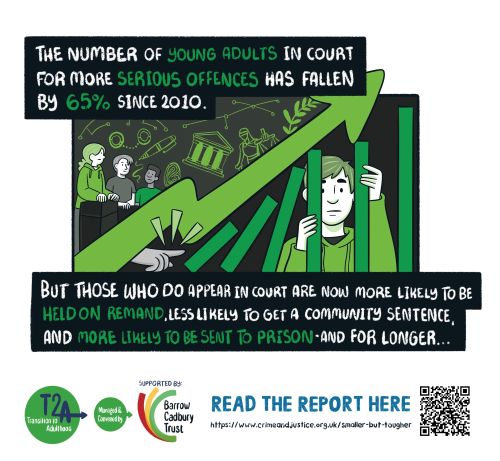
Our analysis of 15 years of data shows a striking shift in how the criminal justice system treats young adults. Since 2010, far fewer are appearing in court for serious offences, down by 65 per cent, yet those who do are increasingly likely to be held on remand, less likely to receive a community sentence, and more likely to be sent to prison for longer.
This graphic is an early glimpse of a wider programme of work. We’ll be publishing a full infographic soon, followed by a new report next year that explores the drivers of these trends and their implications for youth justice policy, with a particular focus on persistent gender and ethnic inequalities.
Read the initial report here.
Mike Guilfoyle essay prize to launch next month
The Mike Guilfoyle essay prize, now in its second year, will be launched in January 2026 in partnership with the probation staff union Napo, to honour the late Mike Guilfoyle. Mike Guilfoyle was an active member of Napo and was awarded an honorary life membership by Napo in 2022. Mike wrote regular articles for the Centre on probation practice based on his vast experience. He passed away peacefully in November 2023, and this essay prize is intended as a tribute to him and his work.
It will be open to all serving and former probation staff, as well as those in training to become probation officers.
You can access the guidelines and submission page for last year’s competition here.
Call for comment pieces on jury trials
The Justice Secretary, David Lammy, has set out proposals that would significantly limit the use of jury trials as part of wider efforts to address pressures within the criminal courts. These proposals raise important questions about how the justice system balances efficiency, fairness and access to justice.
We published a comment piece in September by Keir Monteith on this issue, Stop the injustice – keep the juries, which explores one perspective on the debate. We are keen to hear from researchers, practitioners and others with expertise or experience who would like to contribute a short comment piece for our website, including pieces offering different viewpoints on the role, scope and future of jury trials
If you are interested in writing, please get in touch.
What’s What in The British Journal of Criminology?
For more than sixty years, The British Journal of Criminology (BJC) has published some of the most significant research in the field.
A number of open-access advance articles were published this month:
- Neil Chakraborti rehumanises the harms associated with hate crimes
- Siobhan Headd and Dominic Willmott investigate, through mock-trials, the effects of pre-trial juror attitudes on verdict decisions in rape trials
- Laura Kelly-Corless and Daniel McCulloch explore the post-prison reintegration experiences of Deaf people in England and Wales
- Diana Bociga, Elisa Bellotti and Nicholas Lord use social network analysis to examine the UK’s anti-money laundering (AML) regime
- Adam White explores the rise and fall of the largest police outsourcing deal in UK history
- Susie Hulley examines the moral weight of murder
- April Murphy shares findings from interviews with practitioners working within the sexual violence support sector in Australia
- Amy Cortvriend and Vardan Petrosian explain the intersectional harm affecting mothers in the UK asylum system
- Conor Wilson, Estelle Clayton and Mike Rowe (re)define the boundaries of police stops to draw out the limits of stop and search reform
- Peng Zhang and Hongming Cheng present a theoretical framework for understanding white-collar crime in Chinese football
Prison Service Journal Archive
We are in the process of digitising and uploading the entire back catalogue of Prison Service Journal, from the first edition in 1960. A complete run from 1960 to 1991 is currently available, alongside a complete run from September 2010 to the present day.
This month the PSJ editors have highlighted articles from editions 16 through 18.
Edition 16
After Care and the Prison Officer by J E Thomas, emphasises that prison officers play a crucial role in rehabilitation. The author criticises the A.C.T.O. report on "Organization of After-care" arguing that while officers are correctly seen as capable of engaging in constructive tasks, they are incorrectly perceived as facing insurmountable obstacles. Thomas suggests that proactive prison officers should address these challenges and not allow others to undermine their efforts and abilities.
Edition 17
Growing Up In Prison, by David Atkinson, describes the case of children serving indeterminate sentences, made over the course of 5 years, and reflects on their circumstances, needs, experiences, and treatment.
Edition 18
In the article Our New Prisons, Brian Proctor explores how prison architecture could be redesigned to better support rehabilitation by mimicking community structures. It advocated for flexible, small-group housing units that foster social interaction and personal development, contrasting sharply with the rigid, security-focused designs of traditional Victorian prisons. The piece argues that future prison construction should prioritise adaptability and experimentation to align with evolving sociological and penological insights.
News from our partners
New publication: Crime, Harm and the State
We are pleased to highlight Crime, Harm and the State (Bristol University Press, 2025) by Lynne Copson, Eleni Dimou, and Steve Tombs. The book explores how states define and respond to harm, and why some harms, including corporate and environmental harms, are often ignored while interpersonal harms are criminalised.
Drawing on zemiology, green and cultural criminology, decolonial and migration perspectives, the 14-chapter volume examines the uneven distribution of harm locally and globally, revealing how economic and political interests shape what is labelled a crime.
Part of Bristol University Press’ Studies in Social Harms series, the book combines theory and empirical research to offer a critical perspective on contemporary harm.
Find out more at the Bristol University Press page.
Suresh Grover gives evidence to the Undercover Policing Inquiry (UCPI)
Last month, Suresh Grover, from the Monitoring Group, gave evidence to the Undercover Policing Inquiry (UCPI) about the long-running surveillance of the Southall Monitoring Group and, later, the Monitoring Group.
In his testimony, Suresh described his early experiences of racist violence, the formation of the Southall Monitoring Group, and his work supporting families affected by racist attacks and police misconduct, including his involvement in the Stephen Lawrence family campaign. He also addressed the accuracy of undercover police reports and the impact of covert policing on his work and organisation.
His evidence forms part of the Inquiry’s examination of the Special Demonstration Squad between 1993 and 2007.
A full transcript of his evidence is available on the Undercover Policing Inquiry website.
Support our work
In the last 12 months, around one pound in every ten we received in income came from individual donations. We are so appreciative of the vital support we receive from our donors and supporters.
If you like what we do, and can afford to make a donation to support our important work, we would be very grateful.
You can also spread the word about our work by forwarding this bulletin to others and encouraging them to sign up.


